What The Service Involves
A lost key can leave you wondering who still has access to a building. Electronic access control makes permissions easier to manage through individual credentials, door groups and time schedules. Our approach begins with the daily movement of staff, contractors and visitors, rather than choosing a reader before understanding how the entrance needs to work.
A single office door may need a simple standalone reader. A shared building or warehouse can need a networked system that lets an administrator change permissions across several entrances. We consider how credentials are issued, how temporary visitors are admitted and how access is removed when a tenancy, contract or employment ends.
A System That Fits The Building
The reader is only one part of the installation. Door construction, hinges, closers, locks, power supplies and exit hardware affect whether the system will work reliably. A door that does not close consistently needs attention before electronic locking is added, otherwise the software can report a secure command while the physical entrance remains open.
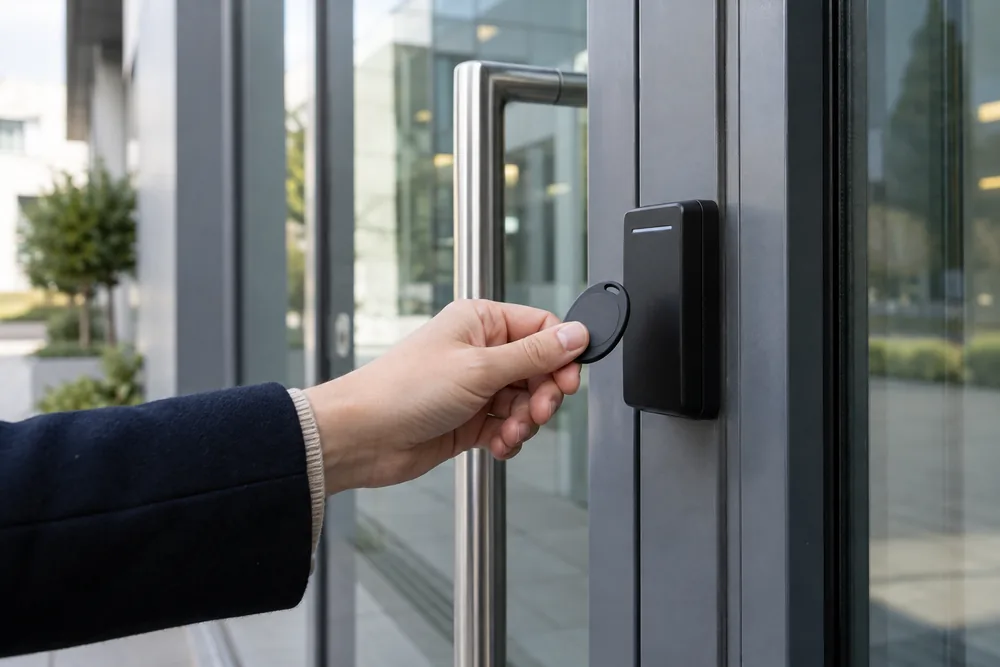
Fobs and cards can be assigned to named users without placing names on the credential itself. Shared PINs are convenient but make it harder to understand who entered and to remove one person’s permission. Mobile credentials may be an option where compatible, with the subscription, device policy and recovery arrangements explained before a platform is selected.
The right access. At the right door.
When To Review Your Security
Access control is useful when keys circulate between shifts, a building contains restricted rooms or permissions need frequent changes. It can also help separate tenant areas from shared entrances. Explain any deliveries, cleaners, lone working or public opening hours at the survey, because those exceptions often shape the best arrangement for the main doors.
Standards And Responsibilities
BS EN 60839-11-1 and BS EN 60839-11-2 cover electronic access control system requirements and application guidance. In England, escape arrangements must also be considered under the Regulatory Reform (Fire Safety) Order 2005. Access records containing personal information need suitable UK GDPR controls, while the Equality Act 2010 is relevant to accessible use.
Read the relevant technical guidance
How The Work Is Planned
- Map the entrances, people and access schedules. Agree who can authorise permissions and which doors form part of an escape route.
- Check door hardware, power and cabling with the building’s fire safety arrangements. Decide the correct behaviour during power loss and emergencies.
- Install readers, controllers and appropriate locking hardware. Test valid and invalid credentials, exit operation, door closure and any agreed fire interface.
- Train the nominated administrator to add users, revoke lost credentials and review logs. Document emergency release arrangements and ongoing door checks.
What Affects The Cost
Access control costs depend on door condition, locking hardware, cable routes and the number of controlled entrances. Central administration, remote sites and mobile credentials can add software or subscription charges. A written proposal should identify any joinery, electrical work, fire alarm coordination or ongoing licences separately, so the whole project is understood before equipment is ordered.
Choose Permissions Before Credentials
Start by listing groups of people and the doors they genuinely need. Office staff, cleaners and delivery contractors may all require different schedules, while a temporary visitor might need accompanied entry rather than a permanent fob. Keep a process for authorising changes when managers are absent. This approach makes the system easier to administer and reduces the temptation to issue a universal credential that defeats the purpose of controlling individual access in the first place.
Handover And Ongoing Care
Keep the permissions list current and give administration rights only to people who need them. Review temporary credentials and contractor access rather than allowing them to remain active indefinitely. During handover, ask for a demonstration of a lost fob being revoked, an emergency exit being used and the behaviour of each door when normal power is unavailable.
Your Questions Answered
Will Access Control Still Allow People To Escape?
Access control must be designed around safe escape as well as security. The correct release arrangement depends on the door, the people using it and the building’s fire risk assessment. Emergency operation, loss of power and any fire alarm interface should be agreed and tested as part of the installation, rather than assumed from the lock type.
What Happens If Someone Loses An Access Fob?
A lost access fob should be reported to the person administering the system so that its permission can be revoked. Individual credentials allow that change without replacing every other user’s fob. The exact process depends on the platform, and a standalone system may require a different procedure from centrally managed doors, which should be demonstrated at handover.
For a proposal based on your building, tell us about your access control systems requirements in Coventry.